Wednesday
Apr152026
2026-10 The de Borda rule
 Wednesday, April 15, 2026
THE DE BORDA RULE:
A MAJORITY VOTE MAY BE FAIR IF,
AND ONLY IF,
ITS DICHOTOMY IS A DUALITY.
DEMOCRACY IS FOR
EVERYBODY, NOT
JUST FOR A (OR
THE) MAJORITY.
-/-/-/-/-/-/-/-/-/-
* * * * *
The Institute is named after Jean-Charles de Borda, and hence the well-known voting procedure, the Borda Count BC; but Jean-Charles actually invented what is now called the Modified Borda Count, MBC - the difference is subtle:
In a vote on n options, the voter may cast m preferences; and, of course, m < n.
In a BC, points are awarded to (1st, 2nd ... last) preferences cast according to the rule (n, n-1 ... 1) {or (n-1, n-2 ... 0)} whereas,
in an MBC, points are awarded to (1st, 2nd ... last) preferences cast according to the rule (m, m-1 ... 1).
The difference can be huge, especially when the topic is controversial: the BC benefits those who cast only a 1st preference; the MBC encourages the consensual, those who submit not only a 1st preference but also their 2nd (and subsequent) compromise option(s). And if (nearly) every voter states their compromise option(s), an MBC can identify the collective compromise.
_/-_/-_/-_/-_/-_/-_/-_/-
DECISION-MAKER
Inclusive voting app
https://debordavote.com
THE APP TO BEAT ALL APPS, APPSOLUTELY!
(The latest in a long-line of electronic voting for decision-making; our first was in 1991.)
_/-_/-_/-_/-_/-_/-_/-_/-
FINANCES
The Institute was estabished in 1997 with a cash grant of £3,000 from the Joseph Rowntree Charitabe Trust, and has received the occasional sum from Northern Ireland's Community Relations Council and others. Today it relies on voluntary donations and the voluntary work of its board, while most running expenses are paid by the director.
_/-_/-_/-_/-_/-_/-_/-_/-
A BLOG
"De Borda abroad." From Belfast to Beijing and beyond... and back. Starting in Vienna with the Sept 2017 TEDx talk, I give lectures in Belgrade, Sarajevo, Istanbul, Tbilisi, Yerevan, Tehran, Beijing, Tianjin, Xuzhou, Hong Kong and Taiwan... but not in Pyongyang. Then back via Mongolia (where I had been an election observer in June 2017) and Moscow (where I'd worked in the '80s).
I have my little fold-up Brompton with me - surely the best way of exploring any new city! So I prefer to go by train, boat or bus, and then cycle wherever in each new venue; and all with just one plastic water bottle... or that was the intention!
In Sept 2019, I set off again, to promote the book of the journey. After the ninth book launch in Taipei University, I went to stay with friends in a little village in Gansu for the Chinese New Year. The rat. Then came the virus, lockdown... and I was stuck.
_/-_/-_/-_/-_/-_/-_/-_/-
|
The Hospital for Incurable Protestants The Mémoire of a Collapsed Catholic This is the story of a pacifist in a conflict zone, in Northern Ireland and the Balkans. Only in e-format, but only £5.15. Available from Amazon. |
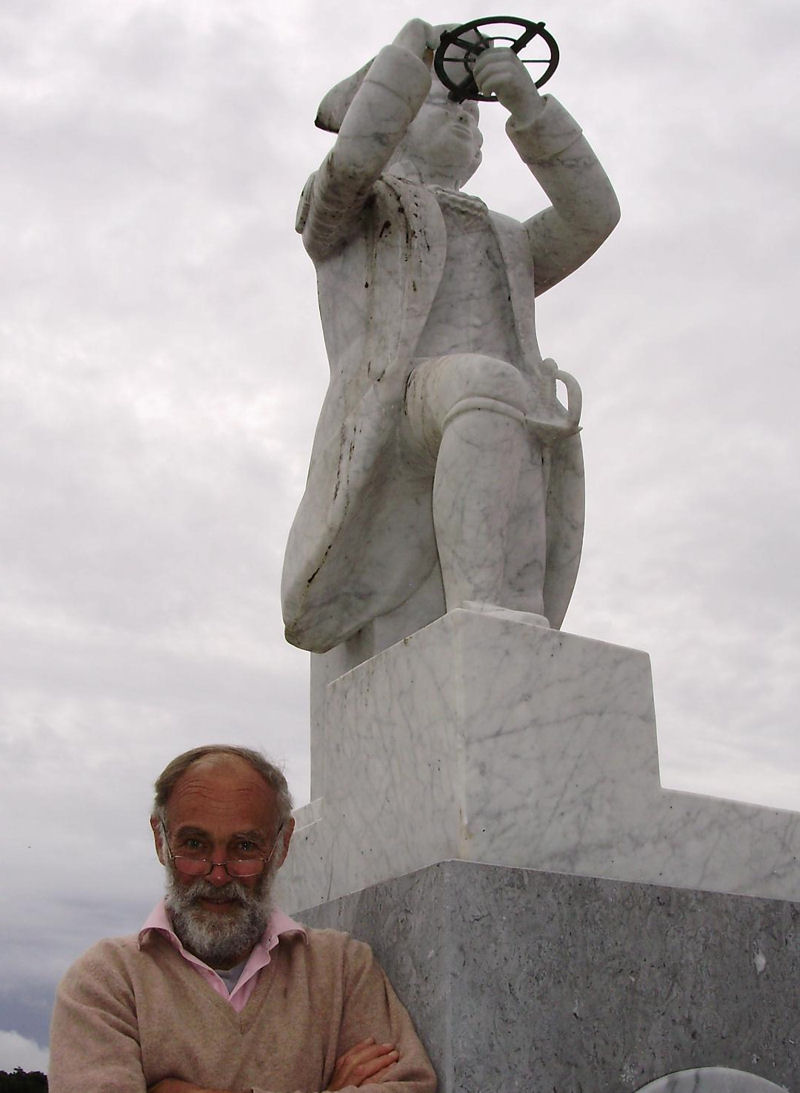
The director alongside the statue of Jean-Charles de Borda, capitaine et savant, in l’École Navale in Brest, 24.9.2010. Photo by Gwenaelle Bichelot.


Here's the YouTube, the PowerPoint, and the text of the speech (more or less).
Wednesday, April 15, 2026
THE DE BORDA RULE:
A MAJORITY VOTE MAY BE FAIR IF,
AND ONLY IF,
ITS DICHOTOMY IS A DUALITY.
Thursday, April 9, 2026 The CRC (Community Relations Council) has just published https://www.community-relations.org.uk/news-centre/decision-making-story-so-far-de-borda-institute
Tuesday, March 31, 2026 EGALITARIAN DECISION-MAKING Alas, the world still uses the 2,500-year-old majority vote! On 29th March, yet another international conference ended without an agreement:
Saturday, March 21, 2026 On Monday 13th April, at 4 pm, INCORE held a 'de Borda' talk, on-line, on the theme:
Majority voting may be fair if, and only if, its dichotomy is a duality.
Most politicians don't question majority rule; they want a system where they win only everything, even if on just 50% + 1 of the vote; to win everything now, or next time. It's worse in the COP talks: many countries want either to win everything or to lose nothing, a majority vote or a veto. But to have a voting procedure which facilitates a compromise? which is egalitarian?
Business also has too many vested interests, with leaders on majority shareholdings, and so on.
Monday, February 23, 2026 THE LESSONS OF WAR! 1 In 1991, Ukraine
Wednesday, February 18, 2026 THE DE BORDA RULE Majority voting may be fair, if its dichotomy is a duality. On 2nd March in the Centre for Conflict Resolution in Munich, I said: I was in Tibet last year so, of course,
Wednesday, February 4, 2026 少数服从多数 (shǎoshū fúcóng duōshū) The minority obeys the majority. This, it seems, is also the guiding 'principle' of decision-making in China. The results of an 8-month research project in ten provinces in China, includng Xīnjiāng, Inner Mongolia and Tibet, are now published in
https://omrpublication.com/wp-content/uploads/2026/02/OJAHACS_2ND_2025.pdf
Tuesday, January 13, 2026 In February 2004, I did a role-play on consensus in Belfast City Council for the Policy and Resources Committee. And I was successful: they achieved consensus, well, sort of. Basically, 'these'uns' did not want to be in consensus with 'them'uns,' and vice versa, so there was a consensus against consensus.
And today, 20-odd years later, with power-sharing and all, little has changed. Some noted tht the culture of all concerned is a bit negative; well of course it is, that's what often happens with majority voting, no matter what sort is used. Oddly, however, lots of academics and journalists etc. also act as if democratic decisions have to be taken in binary ballots, even though multi-option voting has been around for 1,900 years, and preferential voting for 600. Strange.
Tuesday, January 13, 2026 Thank you very much for today’s invitation to the de Borda Institute, and, as my presentation will make clear, my thanks must also go to the late Professor Elizabeth Meehan of Queen’s University, the late Dr. John Robb of the New Ireland Group and
Tuesday, January 13, 2026 The de Borda presentation to the Assembly Executive Review Committee took place on 13.01.2026.
Majority rule may be fine. But a majority opinion cannot be identified in a majority vote, or even a series of majority votes. So why is everybody talking about simple, weighted or consociational majority votes, as if they are accurate? Today's presentation shows - no, proves - that majority voting is ancient and hopelessly inadequate.
1. A singleton majority vote - "Option X, yes or no?" - cannot identify a collective opinion, because those who vote 'no' are not even stating their (positive) opinion.
2. A pairing - "Option X or Y?" - is ok, if and only if the two options, X and Y, are a duality: eg, "Shall we drive on the left or on the right?" In contrast, "Should the UK be in the EU or the WTO?" is not ok; it's not a duality; the UK could also be in the EEA or Customs Union, so in this (and many another instance) a multi-option ballot would be needed.
_________
3. Many complain, the Assembly 'culture' is negative. But, with majority voting, of course it is! Power-sharing, and decision-sharing, would best be effected in a preferential ballot: see 2026-02.
