
About us

.

DEMOCRACY IS FOR

EVERYBODY, NOT

JUST FOR A (OR

THE) MAJORITY.


-/-/-/-/-/-/-/-/-/-/-/ 


Another journey to China, via Baku (COP29), Georgia, India, and return via Mongolia, Russia and (therefore) Ukraine.  Here's the blog: https://deborda.substack.com/p/debordaabroad2


-/-/-/-/-/-/-/-/-/-

The de Borda Institute

aims to promote the use of inclusive, multi-optional and preferential voting procedures, both in parliaments/congresses and in referendums, on all contentious questions of social choice.

This applies specifically to decision-making, be it for the electorate in regional/national polls, for their elected representatives in councils and parliaments, for members of a local community group, a company board, a co-operative, and so on.  But we also cover elections.

               * * * * *

The Institute is named after Jean-Charles de Borda, and hence the well-known voting procedure, the Borda Count BC; but Jean-Charles actually invented what is now called the Modified Borda Count, MBC - the difference is subtle:

In a vote on n options, the voter may cast m preferences; and, of course, m < n.

In a BC, points are awarded to (1st, 2nd ... last) preferences cast according to the rule (n, n-1 ... 1) {or (n-1, n-2 ... 0)} whereas,

in an MBC, points are awarded to (1st, 2nd ... last) preferences cast according to the rule (m, m-1 ... 1).

The difference can be huge, especially when the topic is controversial: the BC benefits those who cast only a 1st preference; the MBC encourages the consensual, those who submit not only a 1st preference but also their 2nd (and subsequent) compromise option(s).  And if (nearly) every voter states their compromise option(s), an MBC can identify the collective compromise.

 _/-_/-_/-_/-_/-_/-_/-_/-

DECISION-MAKER
Inclusive voting app 

https://debordavote.com

THE APP TO BEAT ALL APPS, APPSOLUTELY!

(The latest in a long-line of electronic voting for decision-making; our first was in 1991.)

 _/-_/-_/-_/-_/-_/-_/-_/-

FINANCES

The Institute was estabished in 1997 with a cash grant of £3,000 from the Joseph Rowntree Charitabe Trust, and has received the occasional sum from Northern Ireland's Community Relations Council and others.  Today it relies on voluntary donations and the voluntary work of its board, while most running expenses are paid by the director. 

 _/-_/-_/-_/-_/-_/-_/-_/-

 A BLOG 

"De Borda abroad." From Belfast to Beijing and beyond... and back. Starting in Vienna with the Sept 2017 TEDx talk, I give lectures in Belgrade, Sarajevo, Istanbul, Tbilisi, Yerevan, Tehran, Beijing, Tianjin, Xuzhou, Hong Kong and Taiwan... but not in Pyongyang. Then back via Mongolia (where I had been an election observer in June 2017) and Moscow (where I'd worked in the '80s).

I have my little fold-up Brompton with me - surely the best way of exploring any new city! So I prefer to go by train, boat or bus, and then cycle wherever in each new venue; and all with just one plastic water bottle... or that was the intention!

The story is here.

In Sept 2019, I set off again, to promote the book of the journey.  After the ninth book launch in Taipei University, I went to stay with friends in a little village in Gansu for the Chinese New Year.  The rat.  Then came the virus, lockdown... and I was stuck.

_/-_/-_/-_/-_/-_/-_/-_/-

The Hospital for Incurable Protestants

The Mémoire of a Collapsed Catholic

 This is the story of a pacifist in a conflict zone, in Northern Ireland and the Balkans.  Only in e-format, but only £5.15.  Available from Amazon.


_/-_/-_/-_/-_/-_/-_/- 


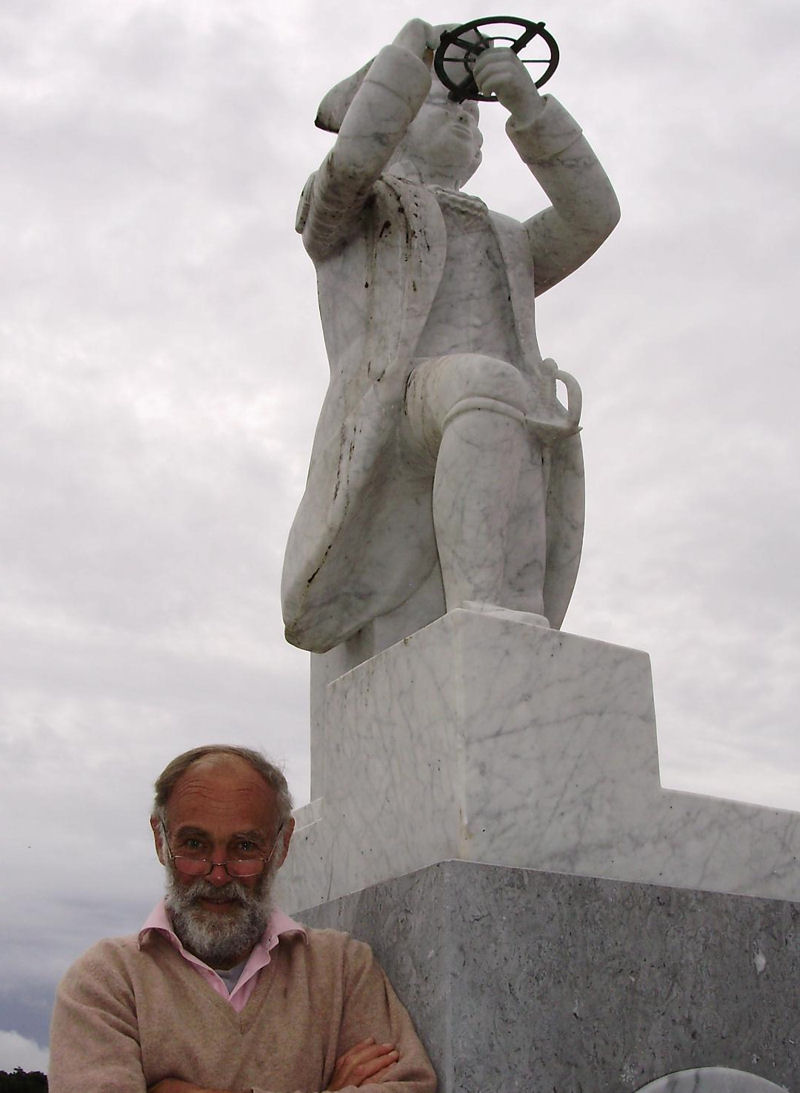
The director alongside the statue of Jean-Charles de Borda, capitaine et savant, in l’École Navale in Brest, 24.9.2010. Photo by Gwenaelle Bichelot. 

Search
Login
Powered by Squarespace
Won by One
WELCOME

Welcome to the home page of the de Borda Institute, a Northern Ireland-based international organisation (an NGO) which aims to promote the use of inclusive voting procedures on all contentious questions of social choice. For more information use the menu options above or feel free to contact the organisation's headquarters. If you want to check the meaning of any of the terms used, then by all means have a look at this glossary.

As shown in these attachments, there are many voting procedures for use in decision-making and even more electoral systems.  This is because, in decision-making, there is usually only one outcome - a singe decision or a shopping ist, a prioritisation; but with some electoral systems, and definitely in any proportional ones, there can be several winners.  Sometimes, for any one voters' profile - that is, the set of all their preferences - the outcome of any count may well depend on the voting procedure used.  In this very simple example of a few voters voting on just four options, and in these two hypothetical examples on five, (word document) or (Power-point) in which a few cast their preferences on five options, the profiles are analysed according to different methodologies, and the winner could be any one of all the options.  Yet all of these methodologies are called democratic!  Extraordinary!

« 2026-20 Slugger, Part IV | Main | 2026-18 Slugger: a critique of majority voting »
Friday
Oct302026

2026-19 Press release 138

 MESMERIED BY “THE MYSTIQUE OF THE MAJORITY,”

The late Professor Sir Michael Dummett, 1984, Voting Procedures, p 178.

Majority voting, the most divisive measure of collective opinion ever invented, is primitive yet ubiquitous. In:

ISRAELI                    elections, no one party or bloc has a majority; so impasse;

FRANCE                    the body politic has two wings but no fuselage; so, stark division;

USA                             in his 1796 farewell address, George Washington said the two-party political system will lead to a “frightful despotism,’ and it now has;

USSR                          the word ‘bolshevik’ большевик, means ‘member of the majority’;

CHINA                       少数 服从 多数,shǎoshù fúcóng duōshù, ‘the minority obeys the majority’; and in

NORTH KOREA,       majority voting, though not often used, is in article 97 of its constitution.

And yet:   

“… binary thinking will never get us beyond partitioned selves, or partitioned nations.”

Naomi Klein, 2023, Doppelganger: 303.) 

Democratic decisions are taken by majority vote, they say, and it’s majority rule.   How then does a majority decide?  By majority vote.  Of course.  That’s democracy.  But a majority of a majority may well be only a minority: 51% of 51% is a mere 26%.  In fact, majority rule rarely exists, and majority administrations are often run by minorities of one, like Trump.

Secondly, democracy is for everybody, not just a majority, {and certainly not just THE majority… of Russians, Jews, Hutus, Sunni… (or pre-1998 Unionists)}. 

Now majority voting is just an ‘x’, ‘for’ or ‘against’.  It’s ancient, divisive, and often inaccurate.  Many have advocated non-binary methodologies.  

-       The first was Pliny the Younger in 105 with plurality voting; it’s still just an ‘x’, and the winner may not be the majority, just the largest minority.  (It’s used in first-past-the-post elections.) 

-       In 1268, after the Dark Ages, came approval voting: more than one ‘x’, for what the voter loves/likes/tolerates.  

-       Next, in 1433, preferential points voting: not ‘x’ but 1-2-3…: and in an n-option ballot, (1st, 2nd … last) preferences get (n, n-1 … 1) points.  

-       And in 1770, Jean-Charles de Borda’s preferendum or Modified Borda Count MBC: if a voter casts only casts m preferences, {and m < n}, the points awarded shall be (m, m-1 … 1).  Ah, a voting procedure which is non-majoritarian: at best, {that is, if (nearly) everyone casts an (almost) full ballot}, the option with the most points is also the option with the highest average preference, and an average, of course, involves every voter, not just a majority of them.  The methodology is inclusive, literally; it’s also fair, robust, very accurate… and egalitarian.

So, in parliament or preferendums, controversial matters should be resolved with an MBC; and governance, everywhere, should always be all-party power-sharing, even in Israel, with the Arabs.  


If indeed humankind is to have a future, it - and its decision-making - will be egalitarian!


PrintView Printer Friendly Version

EmailEmail Article to Friend