
About us

.

THE DE BORDA RULE


A MAJORITY VOTE

 MAY BE FAIR IF, 

  AND ONLY IF,

ITS DICHOTOMY 

  IS A DUALITY.


DEMOCRACY IS FOR

EVERYBODY, NOT

JUST FOR A (OR

THEMAJORITY.


-/-/-/-/-/-/-/-/-/-/-/ 


Another journey to China, via Baku (COP29), Georgia, India, and return via Mongolia, Russia and (therefore) Ukraine.  Here's the blog: https://deborda.substack.com/p/debordaabroad2


-/-/-/-/-/-/-/-/-/-

The de Borda Institute

aims to promote the use of inclusive, multi-optional and preferential voting procedures, both in parliaments/congresses and in referendums, on all contentious questions of social choice.

This applies specifically to decision-making, be it for the electorate in regional/national polls, for their elected representatives in councils and parliaments, for members of a local community group, a company board, a co-operative, and so on.  But we also cover elections.

               * * * * *

The Institute is named after Jean-Charles de Borda, and hence the well-known voting procedure, the Borda Count BC; but Jean-Charles actually invented what is now called the Modified Borda Count, MBC - the difference is subtle:

In a vote on n options, the voter may cast m preferences; and, of course, m < n.

In a BC, points are awarded to (1st, 2nd ... last) preferences cast according to the rule (n, n-1 ... 1) {or (n-1, n-2 ... 0)} whereas,

in an MBC, points are awarded to (1st, 2nd ... lastpreferences cast according to the rule (m, m-1 ... 1).

The difference can be huge, especially when the topic is controversial: the BC benefits those who cast only a 1st preference; the MBC encourages the consensual, those who submit not only a 1st preference but also their 2nd (and subsequent) compromise option(s) And if (nearly) every voter states their compromise option(s), an MBC can identify the collective compromise.

 _/-_/-_/-_/-_/-_/-_/-_/-

DECISION-MAKER
Inclusive voting app 

https://debordavote.com

THE APP TO BEAT ALL APPS, APPSOLUTELY!

(The latest in a long-line of electronic voting for decision-making; our first was in 1991.)

 _/-_/-_/-_/-_/-_/-_/-_/-

FINANCES

The Institute was estabished in 1997 with a cash grant of £3,000 from the Joseph Rowntree Charitabe Trust, and has received the occasional sum from Northern Ireland's Community Relations Council and others.  Today it relies on voluntary donations and the voluntary work of its board, while most running expenses are paid by the director. 

 _/-_/-_/-_/-_/-_/-_/-_/-

 A BLOG 

"De Borda abroad." From Belfast to Beijing and beyond... and back. Starting in Vienna with the Sept 2017 TEDx talk, I give lectures in Belgrade, Sarajevo, Istanbul, Tbilisi, Yerevan, Tehran, Beijing, Tianjin, Xuzhou, Hong Kong and Taiwan... but not in Pyongyang. Then back via Mongolia (where I had been an election observer in June 2017) and Moscow (where I'd worked in the '80s).

I have my little fold-up Brompton with me - surely the best way of exploring any new city! So I prefer to go by train, boat or bus, and then cycle wherever in each new venue; and all with just one plastic water bottle... or that was the intention!

The story is here.

In Sept 2019, I set off again, to promote the book of the journey.  After the ninth book launch in Taipei University, I went to stay with friends in a little village in Gansu for the Chinese New Year.  The rat.  Then came the virus, lockdown... and I was stuck.

_/-_/-_/-_/-_/-_/-_/-_/-

The Hospital for Incurable Protestants

The Mémoire of a Collapsed Catholic

 This is the story of a pacifist in a conflict zone, in Northern Ireland and the Balkans.  Only in e-format, but only £5.15.  Available from Amazon.


_/-_/-_/-_/-_/-_/-_/- 


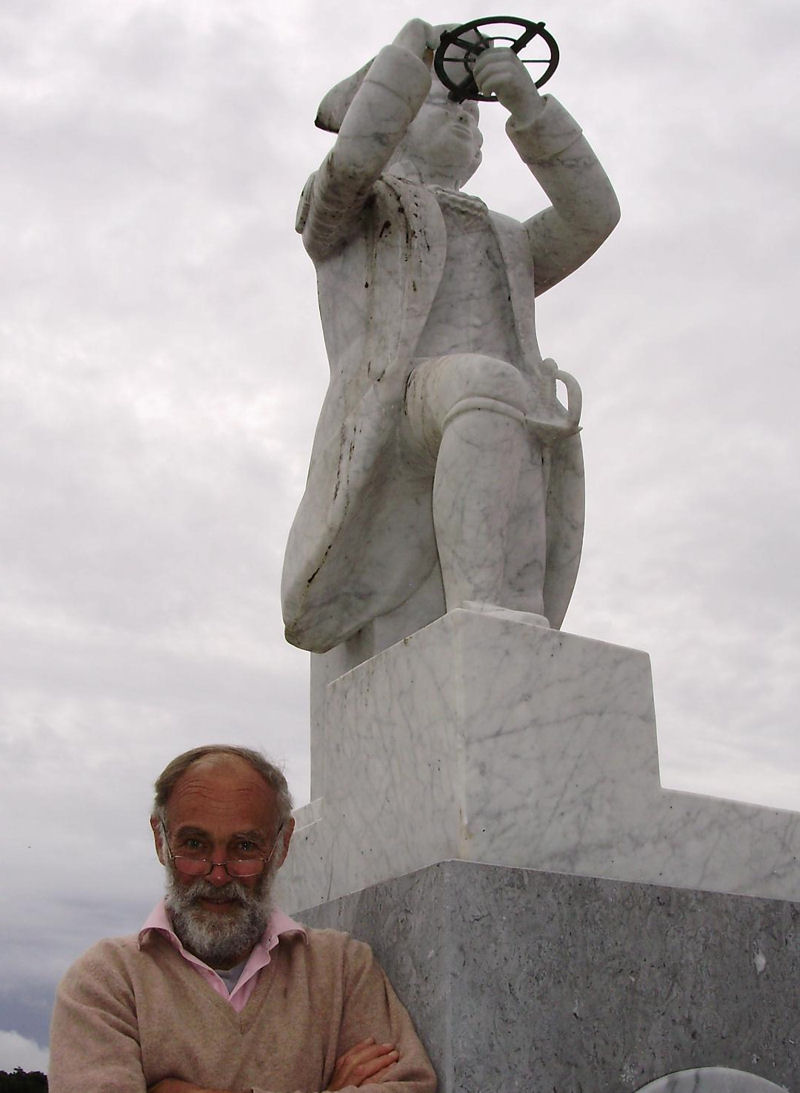
The director alongside the statue of Jean-Charles de Borda, capitaine et savant, in l’École Navale in Brest, 24.9.2010. Photo by Gwenaelle Bichelot. 

Search
Login
Powered by Squarespace
Won by One
WELCOME

Welcome to the home page of the de Borda Institute, a Northern Ireland-based international organisation (an NGO) which aims to promote the use of inclusive voting procedures on all contentious questions of social choice. For more information use the menu options above or feel free to contact the organisation's headquarters. If you want to check the meaning of any of the terms used, then by all means have a look at this glossary.

As shown in these attachments, there are many voting procedures for use in decision-making and even more electoral systems.  This is because, in decision-making, there is usually only one outcome - a singe decision or a shopping ist, a prioritisation; but with some electoral systems, and definitely in any proportional ones, there can be several winners.  Sometimes, for any one voters' profile - that is, the set of all their preferences - the outcome of any count may well depend on the voting procedure used.  In this very simple example of a few voters voting on just four options, and in these two hypothetical examples on five, (word document) or (Power-point) in which a few cast their preferences on five options, the profiles are analysed according to different methodologies, and the winner could be any one of all the options.  Yet all of these methodologies are called democratic!  Extraordinary!

« 2024-20 The FĂ©ile: a Borda border poll | Main | 2024-18 Extremism... or consensus? »
Sunday
Jul072024

2024-19 Politics, the art of compromise

POLITICS, THE ART OF COMPROMISE
IN FRANCE, THE USA AND ELSEWHERE, DEMOCRACY IS IN DANGER OF GIVING POWER TO THOSE
WHO DO NOT COMPROMISE, (AS HAPPENED IN GERMANY WITH THE ENABLING ACT* OF 1933).
If our voting systems catered for compromise,
POLITICS COULD BECOME A GAME OF NO TRUMPS.

CHANGE
THE VOTERS’ ELECTORAL SYSTEM
and
THE MPs' DECISION-MAKING
THE ELECTORAL SYSTEM

First-past-the-post forces voters to be divisive, and parties to be adversarial.

The alternative vote AV allows voters to compromise, and parties to cooperate; some do, but the result does not: AV is not PR.

While single-preference PR may give lots of choice, it offers no opportunity to compromise; this PR-list, however, is fairer to the parties.

Preferential PR,  (a) as in PR-STV, allows voters to compromise (but most DUP and SF voters do not) and, like AV, prompts some parties to cooperate; 
    and     (b) as in QBS§, encourages (but does not force) all voters and parties to compromise.

There are over 300 electoral systems.  In 1996, with a choice of three systems, Slovenians used majority voting, all three options lost, so they took the least unpopular.  Four years earlier, with  a choice of two extreme and three compromise options, New Zealanders used the two-round system TRS on five options… and chose a compromise, half-PR and half-FPTP, as in Germany.  In 2011, in contrast, the UK had a choice of just two systems, FPTP or AV and no compromise; for many a PR supporter, it was like asking a vegetarian, “Beef or lamb?”  And if that 2011 referendum had been multi-optional, maybe the outcome, as in NZ, would have been different.


DECISION-MAKING

This binary voting is ancient, exclusive, very adversarial and frequently inaccurate.  But pluralism is possible.  Plurality voting is often used in the Danish Folketing; TRS (as in French elections) was used in Norway’s decision-making, once; and serial voting is often seen in Sweden and Finland.  TRS has also been used in some referendums, like NZ's in 1992 and Britain’s for Newfoundland in 1948.  

Preferential voting offers the most inclusive decision-making.  As in the MBC it encourages all to state their compromise option(s).  At best, from a ballot of about five options (as would befit a five-party parliament), it can identify the option with the highest average preference.  And an average includes every MP.  The MBC is inclusive, literally!  And far more accurate than any binary ballot.  It could be the basis of an all-party power-sharing polity, as Climate Change might demand.  

THE MBC  -  THE SCIENCE OF COMPROMISE


* A weighted majority vote.

§ The Quota Borda System of 1984 was the brainchild of the late Professor Sir Michael Dummett; it is based on a quota and the MBC.

‡  The Borda Count of 1433 was the prototype of the Modified Borda Count MBC of 1770.   It is a points system: in a five-option poll, he who votes for one option gets his favourite 1 point; she who casts two preferences and thereby states a compromise gets her 1st choice 2 and her 2nd choice 1 point; while those who cast all five options  -  those who recognise the democratic validity of all the (Speaker’s approved) options  -  get 5 points for a 1st, 4 for a 2nd… and 1 point for their 5th preference.  The winner is the option with the most points, and if every MP or voter does cast a full ballot, the result is indeed the option with the highest average preference.  So cooperation can replace confrontation, as (I repeat) Climate Change would demand.


PrintView Printer Friendly Version

EmailEmail Article to Friend